
The European Union said in its ‘negotiating position’ document as it started accession talks with Albania on Tuesday that Tirana must do more to fight corruption and ensure freedom of speech.
The EU’s document also said Tirana must improve the registration and transparency of ownership deeds, while underlining that its economic growth has also been “below potential” .
Albania’s negotiating position has not been published, but a copy of it seen by BIRN contained limited promises beyond a general commitment to achieving the “acquis” – the compatibility of Albanian laws with these of the European Union. The EU position can be seen here.
The main challenges for Albania relate to its justice reform process and the fight against corruption, which has seen several high-level politicians charged or sentenced, including a former deputy prime minister and a former prime minister, along with two dozen lower-level officials.
However, while the change is significant following decades of impunity, Brussels says the process has not gone far enough.
“The EU notes positively some final convictions on corruption charges against high-ranking officials,” the negotiating position document reads. “The EU underlines nevertheless that corruption is prevalent in most areas of public and business life, including in all branches of central and local government and institutions and remains an area of serious concern,” it adds.
“The EU further notes that anti-corruption measures have had overall a limited impact so far particularly in the sectors most at risk of corruption.”
Albania started its flagship justice reform in 2016. Since then, most previous judges and prosecutors has been fired through a vetting process.
The Cadastre Office features heavily as a major problem in the EU’s 27-page document. It calls for “robust anticorruption measures” in the field and underlines that “difficulties with the registration of land titles continue to limit the effective functioning of the market economy”.
Another area of concern is freedom of the speech. While praising Albania’s promises to reform the legal and regulatory framework of the media, the report underlines the need to “strengthen transparency of media ownership, media plurality and editorial independence, strengthen transparency of media financing from private and state resources, and strengthen the autonomy of the media regulator and of the independence of the state broadcaster”.
Albania’s media landscape is dominated by a few television stations whose owners have multiple links with the government, including public-private partnership contracts and public procurements.
The EU notes that an “atmosphere of verbal and physical attacks, smear campaigns and strategic lawsuits against public participation (SLAPP) targeting journalists has not improved and remains to be addressed.”
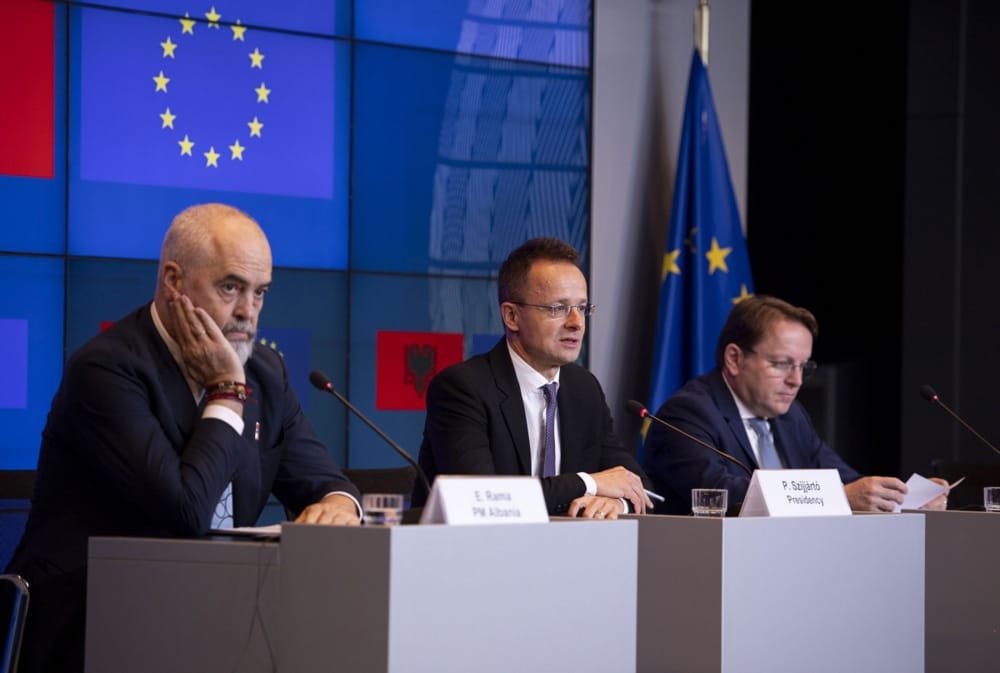
Albania opened accession talks with the EU at an intergovernmental conference in Luxembourg on Tuesday. The first “cluster” of topics under negotiation covers the judiciary and fundamental rights, freedom and security, and procurements and financial control.
Speaking in Luxembourg, Albania’s Prime Minister, Edi Rama, declared that “there is no doubt that we will achieve what should be achieved, which means that Albania [should join] the EU by 2030”.